
You don’t need a commercial gym, a barbell, or a room full of equipment to start strength training.
With a pair of adjustable dumbbells and an adjustable bench, you can build a structured home strength-training routine that covers major movement patterns while giving you plenty of room to progress.
The key isn’t having more equipment. It’s having a plan you can follow consistently.
Want a ready-made 30-day program designed specifically for adjustable dumbbells and a bench?
Start the 30-Day Home Gym Strength Program →
What Equipment Do You Actually Need?
A common mistake when starting home strength training is assuming you need an entire gym.
You don’t.
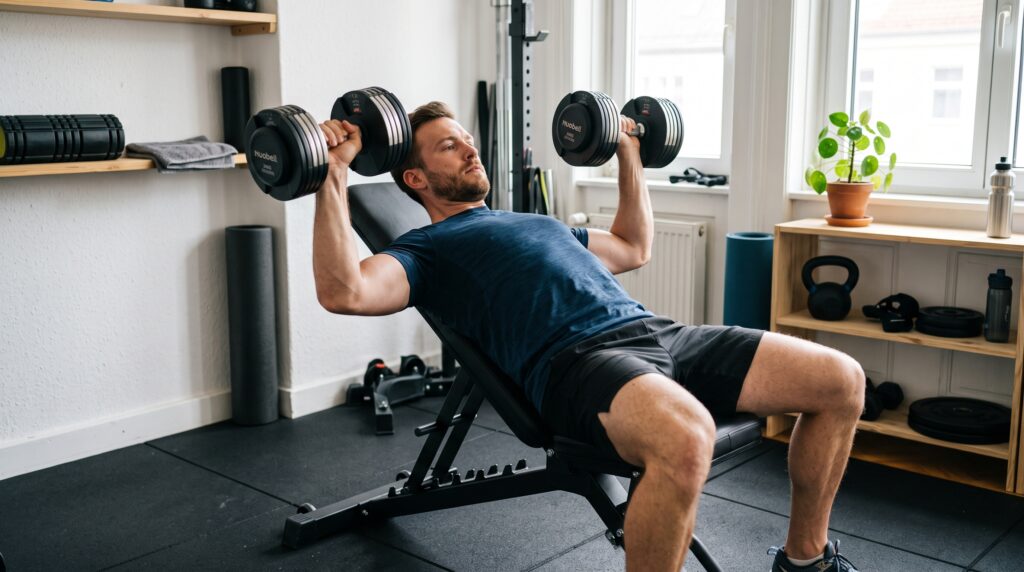
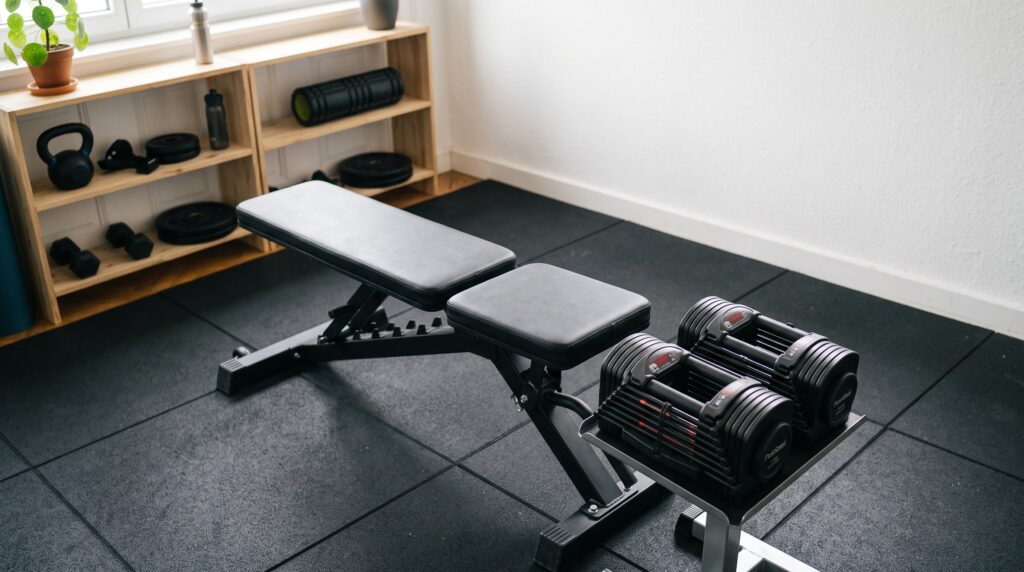
The Home Gym Edition of the 30-Day Strength Challenge is built around two primary pieces of equipment:
Adjustable dumbbells
Adjustable bench
There is no barbell, squat rack, cable machine, or gym membership required. When a bench isn’t essential for an exercise, the program also provides floor-based alternatives.
Why Adjustable Dumbbells?
Adjustable dumbbells are particularly useful for a home setup because the resistance can be changed without needing a complete collection of fixed-weight dumbbells.
They also allow you to perform a wide range of movements for the upper body and lower body.
The program’s exercise library includes movements such as:
Dumbbell floor fly
Dumbbell pullover
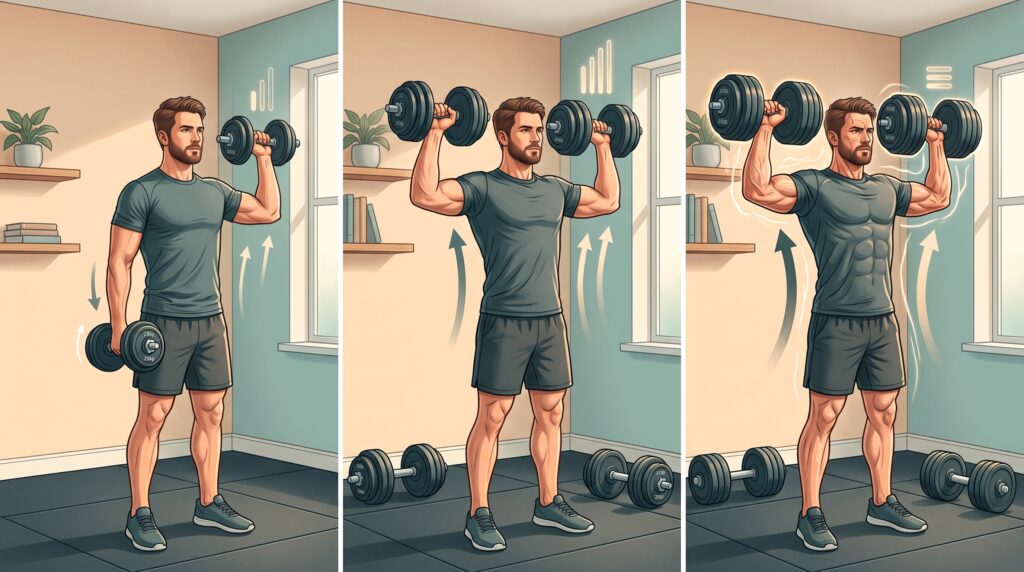
Seated dumbbell shoulder press
Dumbbell lateral raise
One-arm dumbbell row
Chest-supported dumbbell row
Bent-over dumbbell row
Dumbbell reverse fly
How Often Should You Train?
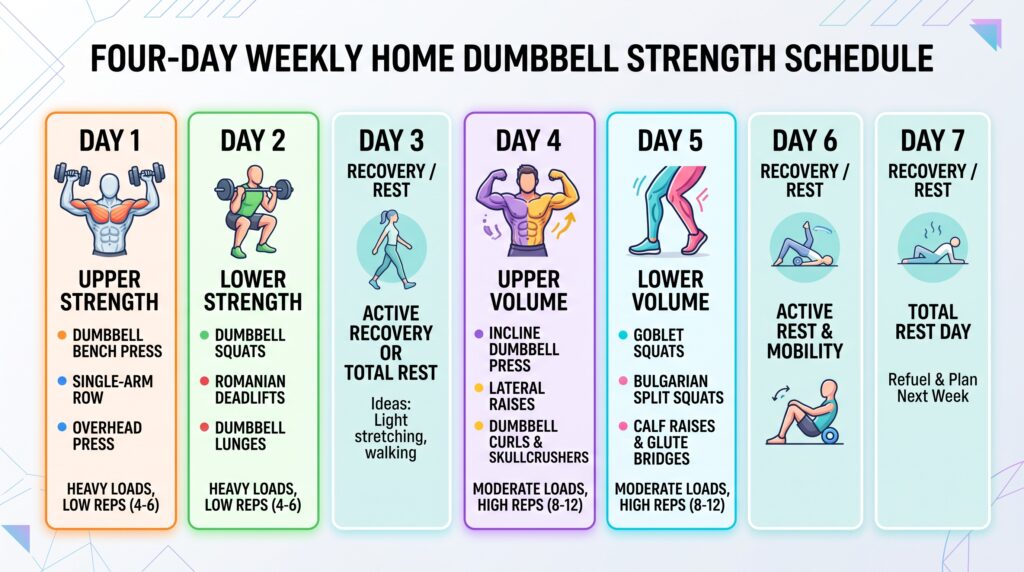
The 30-Day Strength Challenge uses a four-day-per-week training structure.
The program is organized around an Upper/Lower split, with each area trained twice during the week:
Upper Body — Strength
Lower Body — Strength
Upper Body — Volume
Lower Body — Volume
This creates a predictable training rhythm while leaving dedicated recovery time between sessions.
Why Use an Upper/Lower Split?
An Upper/Lower structure makes it easier to organize your training without trying to train every muscle group intensely every day.
You know what you’re training when you start the session, and the program tells you what movements, sets, reps, and targets to follow.
The Home Gym program describes the approach simply: follow the day, log every set, and rest on schedule.
Start With the Major Movement Patterns
You don’t need dozens of exercises in your first home workout.
Instead, focus on learning the major movement patterns and gradually becoming stronger at them.
Dumbbell Pressing
Dumbbells can provide several pressing options for the chest and shoulders.
Examples from the program’s exercise library include dumbbell pressing variations, floor flyes, and seated dumbbell shoulder presses.
When performing these movements, controlled repetitions and appropriate loading matter more than simply using the heaviest dumbbells available.
Dumbbell Rows
Rows provide an important pulling movement for your upper body.
The Home Gym exercise library includes:
One-arm dumbbell rows
Chest-supported dumbbell rows
Bent-over dumbbell rows
Dumbbell reverse flyes
For a beginner, having several variations available is useful because you can select an appropriate movement and use easier alternatives when necessary.
Squatting and Lower-Body Training
Dumbbells aren’t only for upper-body workouts.
You can use them for lower-body movements such as goblet squats, along with other dumbbell-based leg exercises.
The program also includes lower-body training as a dedicated part of its Upper/Lower structure.
Romanian Deadlifts and Hip Hinges
A dumbbell Romanian deadlift provides another way to train the posterior chain using a relatively compact home setup.
The program uses Dumbbell Romanian Deadlift as one of its tracked anchor lifts.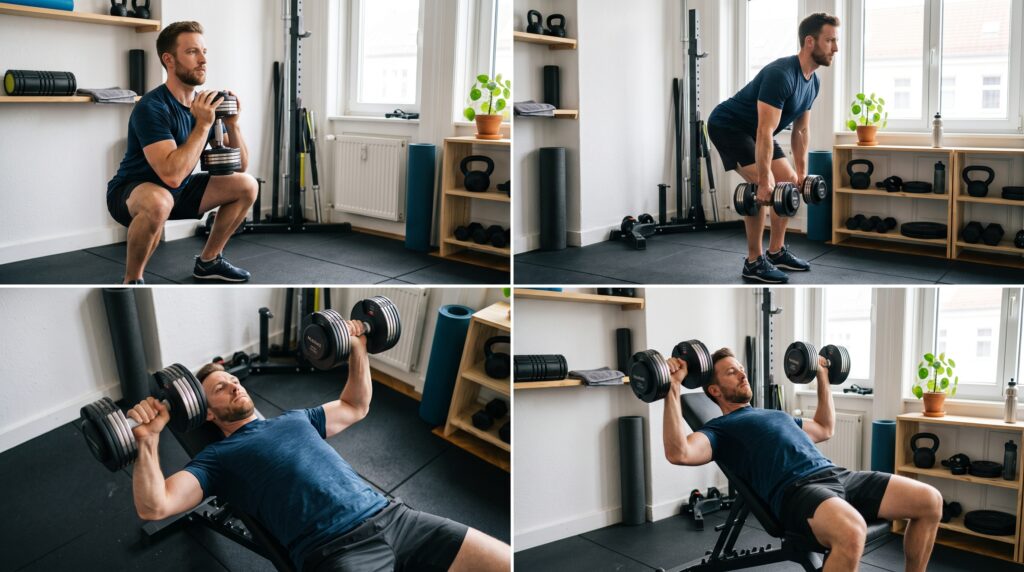
How Many Sets and Reps Should You Do?
There’s no single set-and-rep combination that needs to be used for every exercise.
The important part is having a structured target and progressing appropriately.
The 30-day program provides specific sets × reps targets and uses RPE to communicate how hard a set should feel. For example, an RPE target can indicate how many clean repetitions you should have left at the end of a set.
What Does RPE Mean?
RPE stands for Rate of Perceived Exertion.
In the program, a target such as RPE 7 · 3 left means you should finish the set with approximately three clean repetitions still available.
This is useful for home training because it gives you a way to regulate effort instead of treating every set as a test of how much weight you can possibly lift.
Don’t Chase Failure on Every Set
More isn’t automatically better.
The Home Gym program specifically emphasizes keeping repetitions clean and stopping when form breaks rather than forcing additional repetitions.
Your goal is to build a repeatable training habit—not turn every workout into a maximum-effort test.
How to Progress With Dumbbells
This is one of the most important parts of strength training.
If you perform exactly the same workout with exactly the same difficulty forever, there is little reason to expect continued progress.
The Home Gym program provides several ways to progress.
Increase the Load
When the current weight becomes manageable, you can increase the dumbbell setting.
The program’s progression guidance includes nudging the load upward by approximately 2.5–5% when appropriate while keeping repetitions controlled.
Add Repetitions or Sets
Progress doesn’t always have to mean dramatically heavier dumbbells.
You may also progress by completing more repetitions or adding an additional set when the program calls for it.
Slow Down the Repetition
Tempo can also make a familiar weight more challenging.
The Home Gym program specifically suggests using a slower lowering phase as one way to increase the training stimulus without requiring larger dumbbell jumps.
Why You Shouldn’t Skip Recovery Days
Starting strength training can make it tempting to train every day.
But the 30-day program deliberately includes recovery days.
The Home Gym Edition includes both active recovery and full rest days. Active recovery can include low-intensity movement, stretching, walking, or similar easy activity, while full rest days are specifically intended for recovery.
Recovery Is Part of the Program
Rest isn’t a failure to train.
It’s part of the training structure.
The program emphasizes sleep, adequate nutrition, hydration, and allowing your body to recover before the next training session.
If you’re new to strength training, following the recovery schedule can help make the entire month more manageable.
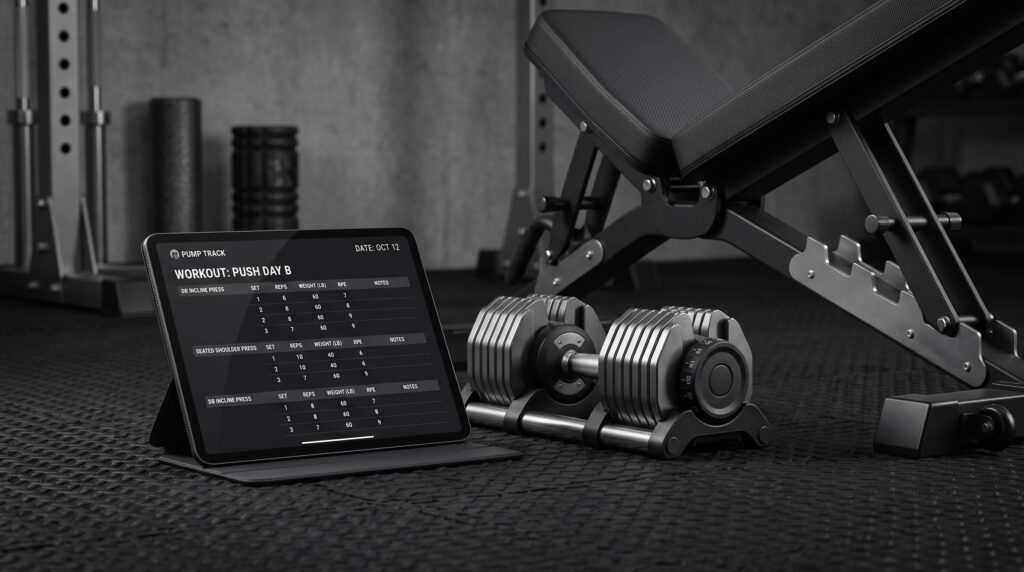
Track Every Workout
One of the easiest ways to lose track of your progress is to rely entirely on memory.
Instead, record your workouts.
At minimum, you want to know:
Which exercise you performed
How much weight you used
How many repetitions you completed
How many sets you performed
How difficult the set felt
How your performance compares with previous sessions
The program is designed around logging each set and comparing your results throughout the challenge.
Why Tracking Matters
Imagine doing a dumbbell bench press in Week 1.
You record the weight and repetitions.
Several weeks later, you can look back and see exactly what you did previously.
That turns “I think I’m improving” into something you can actually compare.
The program’s final review specifically asks you to compare your Day 1 numbers with your results later in the challenge.
What Should Your First 30 Days Look Like?
A structured month can be easier to follow than trying to invent a new workout every morning.
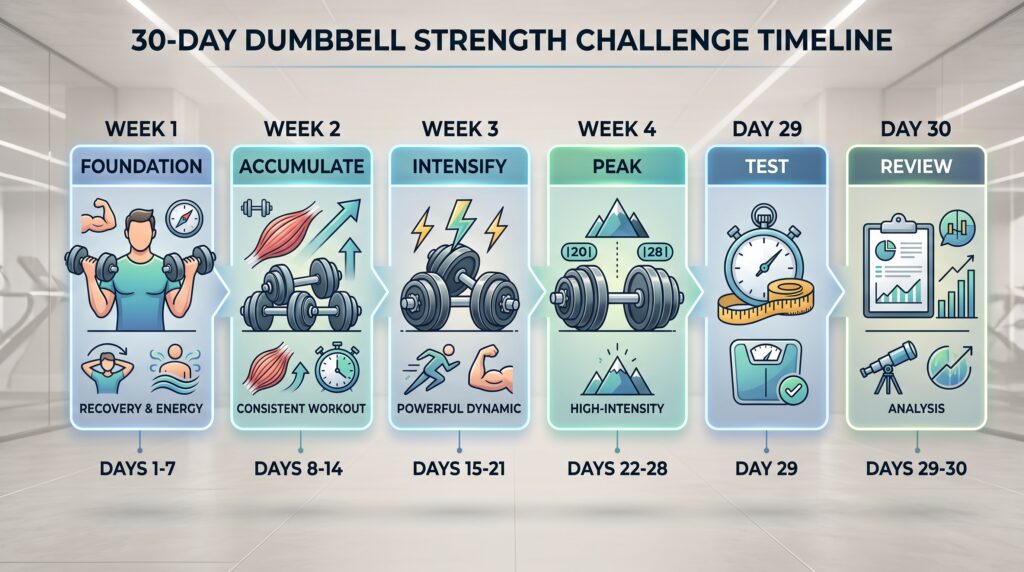
The Home Gym Edition divides the month into progressive phases and includes four training days per week along with recovery days.
A simplified view looks like this:
Week 1 — Build Your Foundation
Focus on learning the movements, establishing appropriate weights, and understanding how the sessions work.
Week 2 — Accumulate
Continue building your workload while maintaining clean technique.
Week 3 — Intensify
Increase the training challenge while continuing to control your repetitions and effort.
Week 4 — Peak
Bring the month toward its strongest training phase before the final test.
Day 29 — Test
Compare selected performance measures against your starting point.
Day 30 — Review & Reset
Look back at what changed, identify what worked, and decide how you want to continue.
The program is specifically designed around this progression from foundation through accumulation, intensification, and peak before the test and review.
Common Mistakes When Training at Home
Buying Too Much Equipment Too Soon
You don’t need to build a commercial gym in your bedroom.
A compact setup with adjustable dumbbells and a bench can already support a structured strength program.
Changing Your Workout Every Week
Constantly switching exercises makes it harder to determine whether you’re actually improving.
A structured program gives you repeated movements and measurable targets.
Using Weight That Is Too Heavy
The heaviest dumbbells aren’t automatically the best choice.
The program emphasizes clean repetitions and appropriate effort rather than grinding through repetitions after technique breaks down.
Ignoring Recovery
Training harder isn’t always the answer.
The program deliberately schedules active recovery and full rest days because recovery is part of the training system.
Not Recording Your Work
If you don’t track your workouts, you lose valuable information about your progression.
Record your sets, repetitions, weights, and relevant notes so you can compare your performance later.
Is Dumbbell Training Enough to Get Started?
For a home-based strength routine, adjustable dumbbells provide a versatile training tool.
The Home Gym Edition demonstrates how a structured 30-day program can be built around adjustable dumbbells and an adjustable bench, without requiring a barbell, rack, cable machine, or gym membership.
You don’t need to wait until you have the perfect home gym.
You can start with the equipment you actually have, follow a structured progression, and build from there.
Ready for a Structured 30-Day Dumbbell Program?
If you don’t want to spend your first week searching for exercises, deciding what to train each day, and guessing how to progress, a structured program can remove much of that decision-making.
The 30-Day Home Gym Strength Program is built specifically around adjustable dumbbells and an adjustable bench.
It gives you:
30 structured days
Four training days per week
Upper/Lower training structure
Progressive training phases
Built-in recovery days
Exercise substitutions
Sets and rep targets
RPE guidance
Progress and PR tracking
A Day 29 test
A Day 30 review
Start the 30-Day Home Gym Strength Program →
You don’t need a commercial gym to start.
You need a workable setup, a structured plan, and the consistency to follow it.
Important Note
This article and the accompanying program provide general fitness information and are not a substitute for medical advice, professional coaching, or physical therapy. The program materials recommend warming up properly, training within your ability, and seeking appropriate professional advice if you have an injury, health condition, are pregnant, or have been inactive. Stop exercising and seek advice if you experience sharp pain, dizziness, chest discomfort, or shortness of breath.