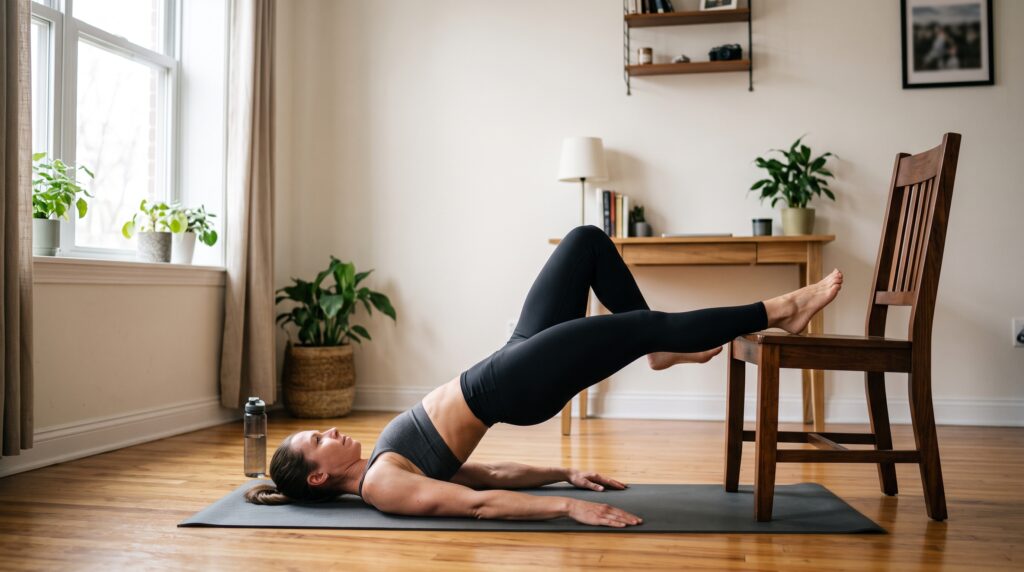
You don’t need a gym membership, dumbbells, or a home gym to start building strength.
With enough floor space and a few sturdy household surfaces, you can follow a structured bodyweight workout plan no equipment and train your entire body from home, a hotel room, or almost anywhere else.
The bigger challenge isn’t finding exercises.
It’s knowing what to do, when to do it, how to make it harder, and when to recover.
That’s where a structured 30-day plan can make a difference.
Ready to follow a complete 30-day bodyweight program?
Get the 30-Day Bodyweight Strength Challenge →
Can You Build Strength Without a Gym?
Yes—but bodyweight training requires a slightly different approach to progression.
You can’t simply add another plate to a barbell or increase the setting on a dumbbell.
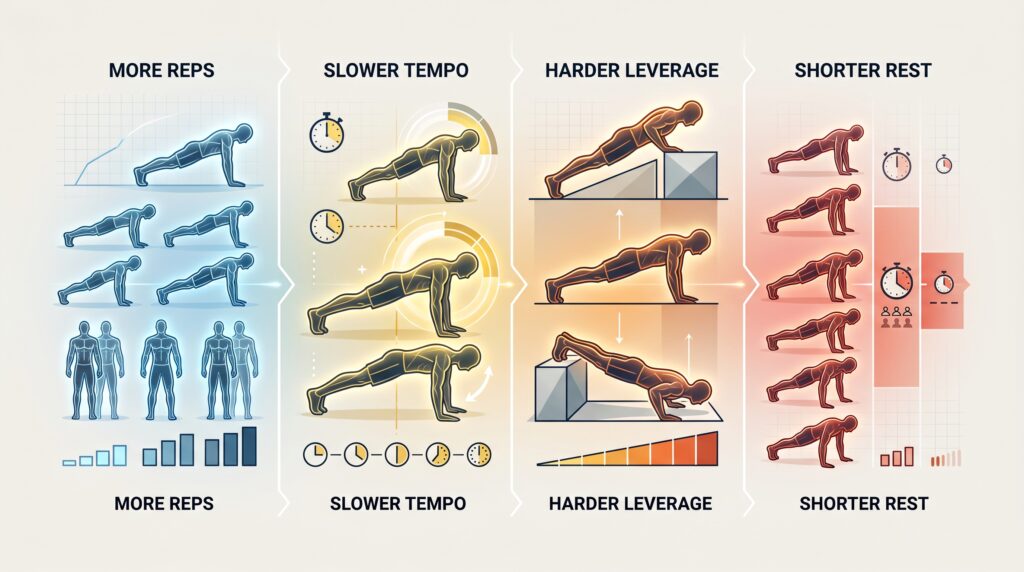
Instead, you can make bodyweight movements harder by changing:
Repetitions
Tempo
Leverage
Exercise variation
Rest periods
The Bodyweight Edition is specifically built around this idea. Its progression system uses repetitions, slower tempo, leverage changes, and reduced rest to increase difficulty without adding external weight.
The result is a workout system that doesn’t depend on a gym.
What Equipment Do You Need?
The answer is intentionally simple.
The Bodyweight Edition requires no equipment that you need to purchase.
The program is designed around:
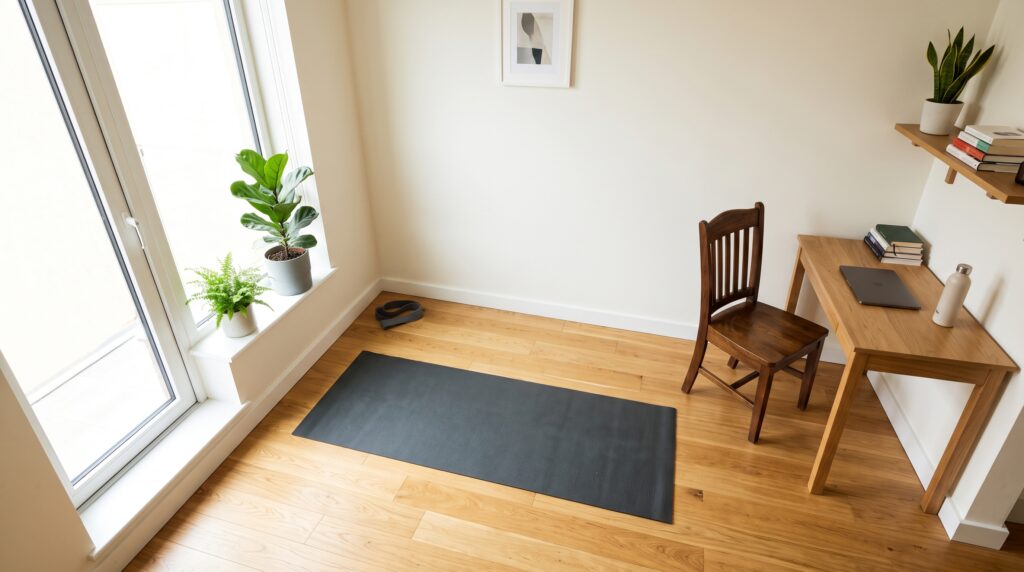
Floor space
A sturdy table or desk
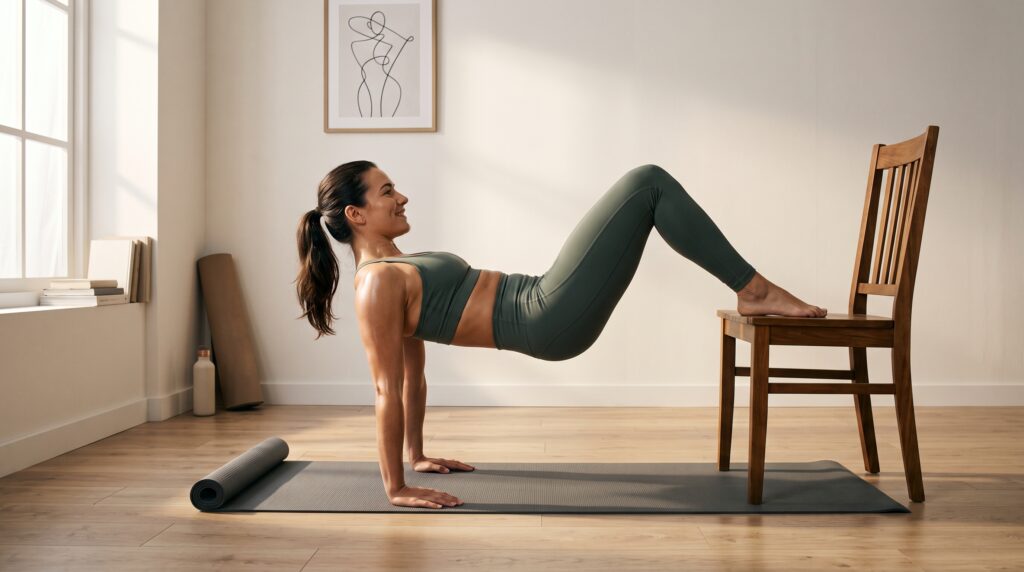
A chair
A wall
That means the workouts can be performed in places such as a bedroom, hotel room, or park.
Why Small Spaces Can Work
You don’t need a dedicated home gym.
A relatively small area can be enough for movements such as push-ups, squats, lunges, planks, and other bodyweight exercises.
The important thing is having enough room to move safely and access to stable surfaces when an exercise calls for one.
How the 30-Day Bodyweight Plan Is Structured
A common mistake with bodyweight training is treating every day as a workout day.
This program doesn’t.
The 30-day structure uses four training days per week, with Upper Body and Lower Body each trained twice:
Upper Body — Strength
Lower Body — Strength
Upper Body — Volume
Lower Body — Volume
The remaining days are dedicated to recovery, including mobility, optional easy activity, and full rest.
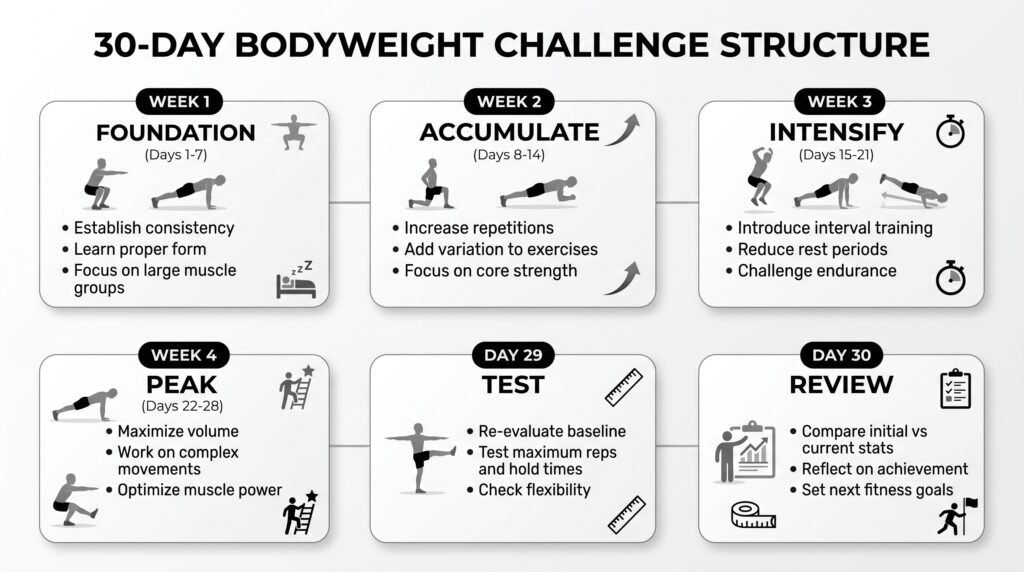
The Four Training Phases
The month progresses through four main phases:
Foundation → Accumulate → Intensify → Peak
The training then tapers before the final test.
This gives the month a purpose instead of simply repeating the same workout for 30 days.
The Best Bodyweight Exercises for Small Spaces
A good small-space workout doesn’t require dozens of movements.
The Bodyweight Edition uses a range of push, pull, lower-body, and core movements, with easier substitutions available when needed.
Push Exercises
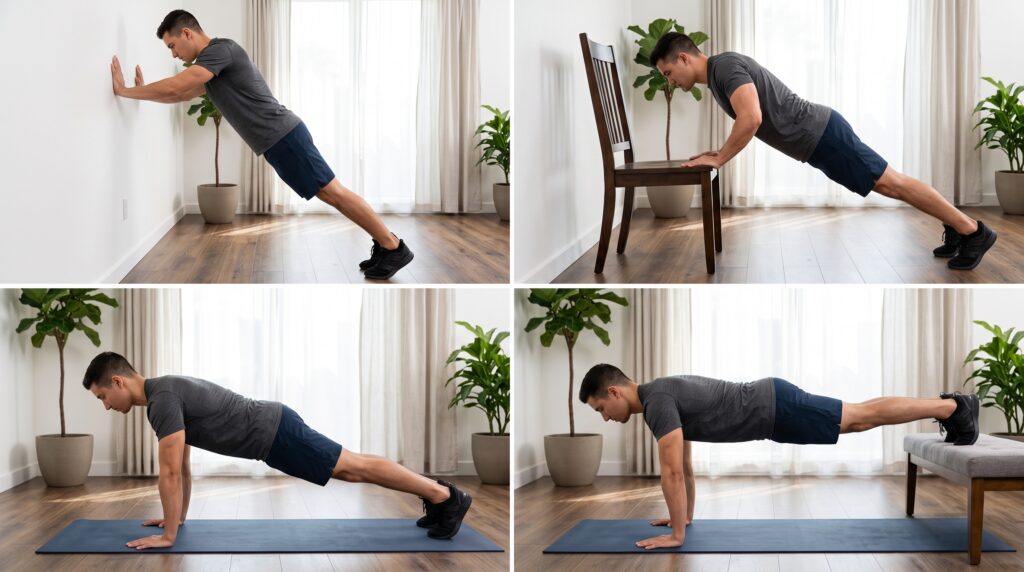
Push-ups are one of the easiest movements to adapt to different ability levels.
The exercise library includes:
Push-Ups
Incline Push-Ups
Decline Push-Ups
Wide Push-Ups
Pseudo Planche Push-Ups
Pike Push-Ups
Wall Push-Ups
Chair Dips
Make Push-Ups Easier
If a standard push-up is currently too difficult, the program provides easier variations.
For example, an incline push-up can be performed with the hands elevated on a chair, while a wall push-up provides an even easier starting point.
Make Push-Ups Harder
As you become stronger, you can progress toward variations such as decline push-ups, pseudo planche push-ups, or pike push-ups.
The point isn’t to rush toward the hardest variation.
It’s to find the variation that matches your current ability and progress gradually.
Pull Exercises
Pulling movements can be more challenging to organize without gym equipment, but a small-space bodyweight routine can still use sturdy household surfaces.
The exercise library includes:
Table Rows
Underhand Table Rows
Door Rows
Prone Y-T-W Raises
Reverse Snow Angels
Safety Comes First
Household furniture should only be used when it is genuinely sturdy and appropriate for the movement.
Never assume a lightweight, unstable, folding, or poorly secured table or door is safe for pulling exercises.
If a surface doesn’t feel secure, don’t use it.
Lower-Body Exercises
You can create a surprisingly challenging lower-body workout without weights.
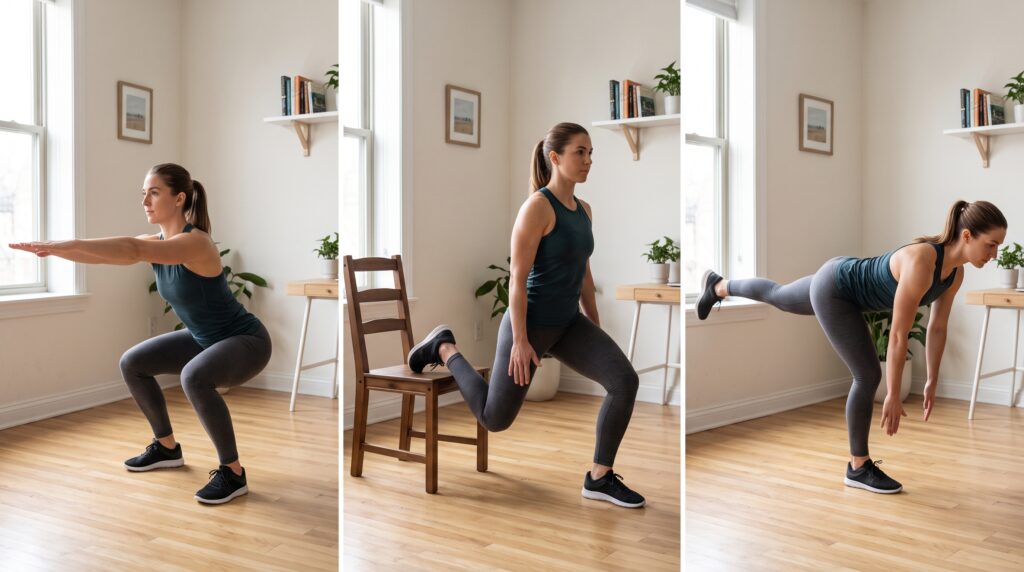
The Bodyweight Edition includes movements such as:
Bodyweight Squats
Lunges
Bulgarian Split Squats
Step-Ups
Single-Leg Romanian Deadlift variations
Wall Sits
Calf Raises
Single-leg variations are particularly useful because one limb can handle more of the work without requiring external weight.
Core Exercises
A small space is more than enough for effective core training.
The exercise library includes movements such as:
Planks
Hollow Holds
Dead Bugs
These exercises require very little space and can be performed on the floor.
How Do You Make Bodyweight Training Harder?
This is one of the most important questions when following a bodyweight workout plan no equipment.
With weights, you have a straightforward progression method: increase the load.
With bodyweight training, you have to manipulate the difficulty.
1. Add Repetitions
The program identifies adding repetitions as the easiest progression lever.
Once you’re consistently exceeding the prescribed repetitions, it’s time to consider a harder progression.
2. Slow Down the Tempo
Try controlling the lowering portion of the movement.
The program uses a 3-second lowering phase with a 1-second pause as one progression method.
This increases the challenge without requiring any additional equipment.
3. Change the Leverage
Leverage is one of the most important tools in bodyweight strength training.
You can make a movement harder by:
Raising your feet
Lowering your hands
Moving from two limbs to one
Choosing a more difficult variation
The program’s exercise library provides progression steps for its movements.
4. Reduce Rest
Reducing rest can increase the difficulty of a workout, but the program places it last in its progression sequence because shorter rest tends to emphasize conditioning more than pure strength.
For strength-focused training, don’t automatically assume that shorter rest is better.
How Hard Should Each Set Feel?
The program uses RPE, or Rate of Perceived Exertion, to regulate effort.
For example:
RPE 7 = approximately 3 reps left
RPE 8 = approximately 2 reps left
RPE 9 = approximately 1 rep left
RPE 10 = no reps left
Most working sets in the program target approximately RPE 7–8.
Why Reps in Reserve Matter
You don’t need to take every set to complete failure.
Instead, select a variation that allows you to perform the target repetitions while maintaining the required number of clean repetitions in reserve.
If you can’t reach the target with good form, use an easier variation.
If you’re comfortably exceeding it, move toward a harder variation.
Don’t Skip the Warm-Up
A small-space workout still deserves a proper warm-up.
The program’s warm-up is organized into three stages:
Raise
Begin with approximately five minutes of easy cardio to increase body temperature.
Mobilise
Use dynamic movements such as arm circles, leg swings, bodyweight squats, and hip-opening movements.
Ramp
Before the first main exercise, perform easier sets of the movement to prepare for the working sets.
The complete warm-up structure is designed to take less than ten minutes.
Recovery Is Part of the 30-Day Plan
One of the biggest mistakes beginners make is assuming that more training automatically produces better results.
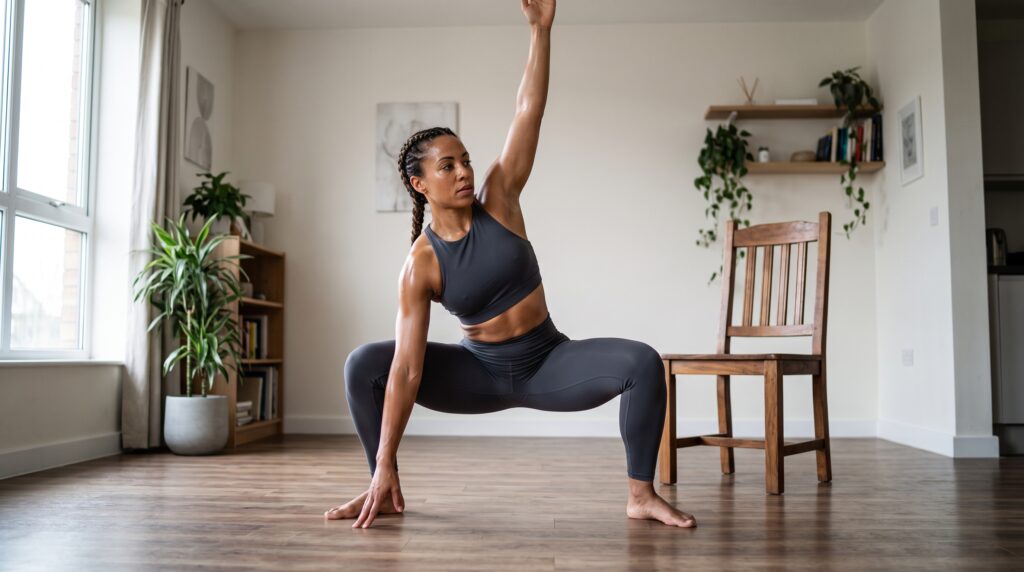
The Bodyweight Edition deliberately includes three recovery days each week:
Mobility
Optional easy activity
Full rest
These days are built into the program rather than added when you’re already exhausted.
What Can You Do on a Recovery Day?
The program includes options such as:
A 20–30 minute easy walk
Mobility work
Light stretching
Hydration
Adequate sleep
A full rest day when necessary
Recovery isn’t a wasted day.
It’s part of the training schedule.
A Simple 30-Day Bodyweight Training Roadmap
Rather than inventing a new workout every day, use the month as a progression.
Week 1 — Foundation
Learn the movements and establish your starting level.
Don’t worry about choosing the hardest variation.
The goal is to perform the prescribed movements with control.
Week 2 — Accumulate
Build your workload while maintaining good movement quality.
Continue recording your sessions so you know what you’ve actually completed.
Week 3 — Intensify
Move toward more challenging variations, additional repetitions, or other appropriate progression methods.
The program’s Week 3 sessions include harder variations such as decline push-ups and table rows alongside other upper-body movements.
Week 4 — Peak
The final training phase brings the month toward its highest planned challenge before the test.
Day 29 — Test
Day 29 isn’t simply another hard workout.
It’s a measurement.
The Bodyweight Edition uses four benchmarks:
Push-Up maximum clean repetitions
Table Row maximum clean repetitions
Bodyweight Squat maximum clean repetitions
Plank maximum hold
The important word is clean.
The program specifically instructs you to use the same exercise variation and setup as Day 1 when comparing results.
Day 30 — Review & Reset
The final day is about looking at what happened during the month.
You compare your results, think about which sessions were difficult, consider how recovery affected training, and identify the habits worth carrying forward.
Who Is This Type of Workout Plan Best For?
A no-equipment bodyweight program is particularly useful if you:
Don’t have a gym membership
Have limited space
Travel frequently
Live in an apartment
Train in a bedroom or small home
Want to avoid buying equipment
Need a flexible workout environment
Are between gyms
Want to start with basic strength training
The Bodyweight Edition specifically describes itself as suitable for people with roughly four days available each week and a bit of floor space. It also provides easier exercise versions for beginners and harder variations for stronger trainees.
What If You’re a Complete Beginner?
You don’t need to start with advanced bodyweight movements.
In fact, you shouldn’t.
The program’s exercise library provides easier variations for many movements. For example, a standard push-up can be modified to an incline push-up, while an incline push-up can be further reduced to a wall push-up.
Start at Your Actual Level
Choose the variation that allows you to complete the prescribed repetitions with good form and the appropriate effort level.
Then progress gradually.
There’s no benefit in choosing an advanced variation simply because it looks impressive.
Consistency beats unnecessary difficulty.
What If Bodyweight Training Becomes Too Easy?
That’s where the progression system becomes important.
You can:
Increase repetitions
Slow down the eccentric portion
Pause at difficult positions
Change leverage
Progress to single-limb variations
Move to a harder exercise variation
The Bodyweight Edition specifically recommends progressing through these levers rather than simply repeating the same movement indefinitely.
And if you eventually purchase dumbbells, you can transition to a weighted home-gym approach. The Bodyweight Edition itself points toward the Home Gym Edition as an option once you have dumbbells.
The Biggest Advantage of a No-Equipment Program
The biggest advantage isn’t that bodyweight training is “better” than gym training.
It’s that equipment is no longer an excuse for skipping the session.
Your workout doesn’t depend on:
Gym opening hours
A membership
Available machines
Transportation
A large workout room
A collection of weights
If you have enough safe space, you can train.
That makes bodyweight training particularly useful for people whose biggest obstacle isn’t motivation—it’s access.
Ready for a Structured 30-Day Bodyweight Plan?
If you’re tired of searching for random bodyweight workouts and want a structured plan that tells you what to do each day, the 30-Day Bodyweight Strength Challenge provides a complete month-long framework.
It includes:
30 consecutive program days
Four training days per week
Upper/Lower training split
Strength and volume sessions
Four progressive training phases
Built-in recovery days
Exercise substitutions
RPE guidance
Exercise library
Progress and PR tracking
Day 29 benchmark testing
Day 30 review and reset
The program is designed around no gym, no weights, and no equipment you need to purchase—just floor space and appropriate sturdy household surfaces.
Start the 30-Day Bodyweight Strength Challenge →
You don’t need a gym.
You don’t need expensive equipment.
You need enough space to move safely, a structured plan, and the consistency to show up.
Thirty days. Your bodyweight. Your space. Your work.