Choosing a workout program shouldn’t start with “What’s the hardest workout I can find?”
It should start with a much simpler question:
Where are you actually going to train?
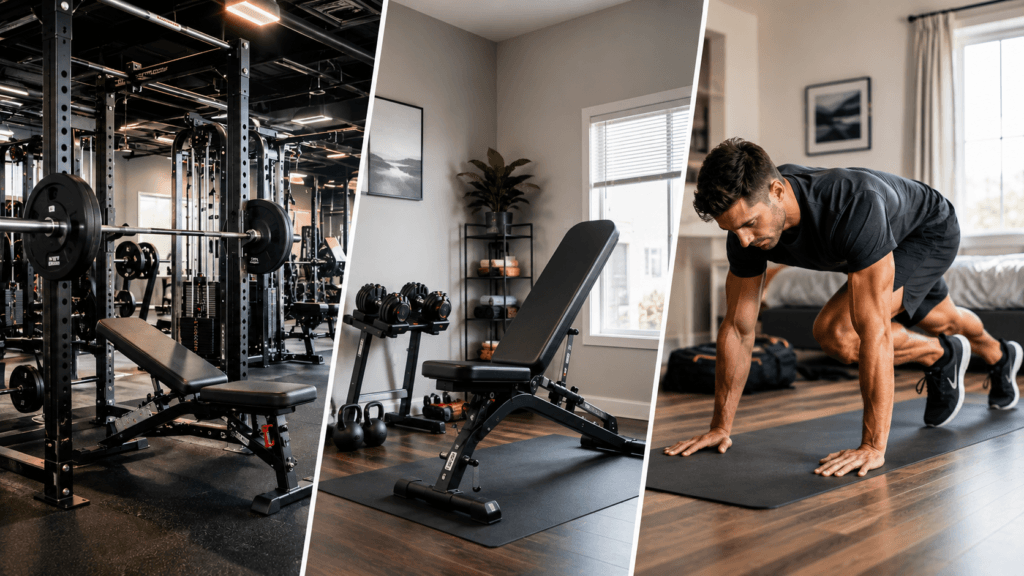
A fully equipped commercial gym gives you access to barbells, racks, cables, benches, and plenty of weight options. A home gym can give you a surprisingly complete strength setup with just adjustable dumbbells and a bench. And if you have no equipment at all, you can still follow a structured strength program using bodyweight movements and everyday surfaces.
The problem is knowing which approach fits your situation.
That’s why the 30-Day Strength Challenge is available in three editions: Full Gym, Home Gym, and Bodyweight. Each follows the same basic training philosophy while adapting the exercises and equipment to where you train.
View the 30-Day Strength Challenge + Workout App Bundle →
The Short Answer
Here’s the simplest way to choose:
| If you… | Choose |
|---|---|
| Have access to a fully equipped gym | Full Gym Edition |
| Train at home with adjustable dumbbells and a bench | Home Gym Edition |
| Have little or no equipment | Bodyweight Edition |
| Travel frequently or train in different locations | Bodyweight Edition |
| Want more exercise and loading options | Full Gym Edition |
| Want a compact setup without a gym membership | Home Gym Edition |
The important thing is that none of these options requires you to choose between “real training” and convenience. The goal is to choose the program you can consistently follow for 30 days.
What Is the 30-Day Strength Challenge?
The three programs are designed around a structured 30-day training cycle rather than 30 consecutive hard workout days.
The basic structure uses four training days per week, with Upper and Lower sessions trained twice: once with a strength focus and once with a volume focus. Recovery is deliberately built into the schedule rather than treated as an afterthought.
The month progresses through different training phases before tapering into a test:
Foundation → Accumulate → Intensify → Peak → Test → Review
Day 29 is the test day, where you compare key performance against your starting point. Day 30 is used to review the month and decide what comes next.
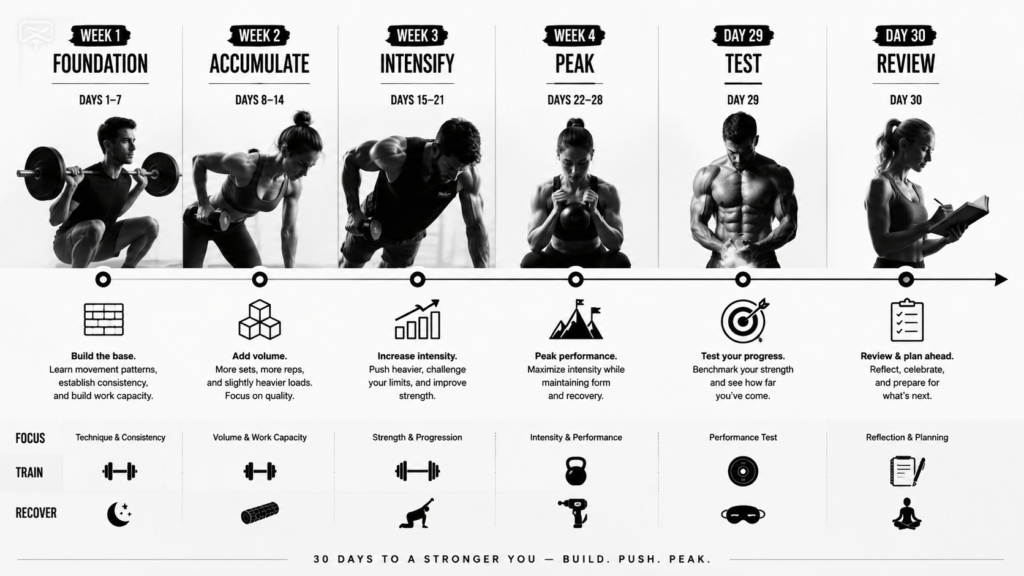
That structure matters because the objective isn’t simply to “work out every day.” It gives you a repeatable training rhythm, progression, recovery, and a defined point at which to evaluate your progress.
1. Full Gym: Best for Maximum Exercise Options
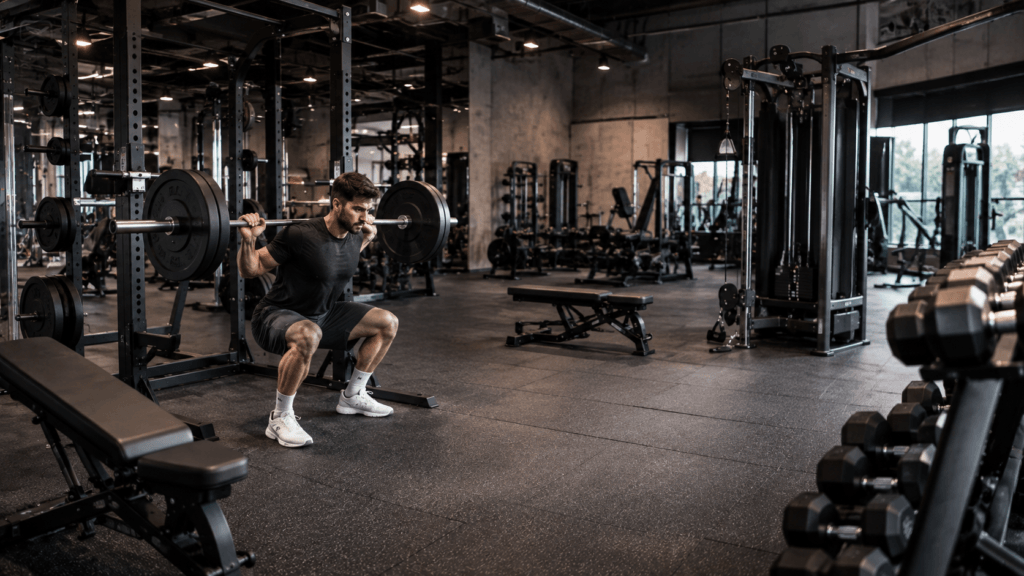
If you regularly train at a commercial gym or have a fully equipped home gym, the Full Gym Edition is the most flexible option.
A full gym gives you access to equipment such as:
Barbells
Squat racks
Adjustable benches
Dumbbells
Cable machines
This environment gives you more ways to load movements and more options for exercise selection.
Who Should Choose the Full Gym Edition?
The Full Gym Edition makes the most sense if:
You already have a gym membership
You have access to barbells and racks
You enjoy traditional strength training
You want more loading options
You want access to cable-based exercises
You don’t mind traveling to a gym to train
The major advantage isn’t simply that there is “more equipment.”
It’s that you have more ways to progress.
If you eventually reach the limits of a particular dumbbell or bodyweight variation, a fully equipped gym gives you additional loading and exercise options.
The Trade-Off
The biggest disadvantage is convenience.
You need access to the gym, transportation or travel time may be involved, and busy periods can mean waiting for equipment.
If you genuinely enjoy going to the gym, this may not be a problem at all.
But if getting to the gym is the reason you repeatedly skip workouts, a smaller home setup may actually be the better choice.
2. Home Gym: Best Balance Between Equipment and Convenience
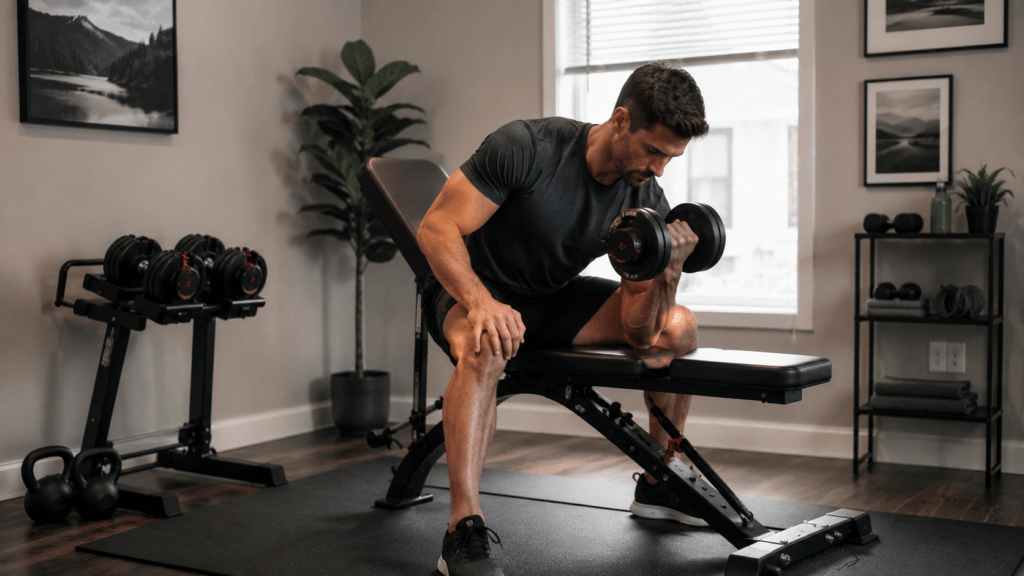
The Home Gym Edition is designed around a surprisingly small equipment list:
Adjustable dumbbells + adjustable bench.
That’s it.
There is no barbell, squat rack, cable machine, or gym membership required. When a bench isn’t essential, the program also provides floor-based alternatives.
Why Choose a Home Gym?
A home gym sits between the other two options.
You have external resistance, but you don’t need an entire room filled with equipment.
Adjustable dumbbells can be used for movements including presses, rows, squats, Romanian deadlifts, shoulder presses, lunges, and many accessory exercises. The program also includes easier substitutions and floor-based alternatives where appropriate.
The Home Gym Edition also uses the same four-day Upper/Lower structure and progressive month-long framework as the other editions.
Who Is It Best For?
Choose the Home Gym Edition if:
You prefer training at home
You own adjustable dumbbells
You have room for a bench
You don’t want a gym membership
You want external resistance without a full gym setup
You value convenience
For many people, this is the middle-ground option.
You get considerably more loading options than bodyweight-only training while avoiding the time and expense of maintaining a full gym setup.
The Trade-Off
The obvious limitation is equipment.
You’re working primarily with dumbbells and a bench, so you don’t have the same range of loading and exercise options available in a fully equipped gym.
But that’s also the point of having a dedicated Home Gym Edition: the program is designed around the equipment you actually have rather than assuming you own a squat rack and barbell.
3. Bodyweight: Best for Maximum Flexibility
Don’t have dumbbells?
No bench?
No gym membership?
That’s where the Bodyweight Edition comes in.
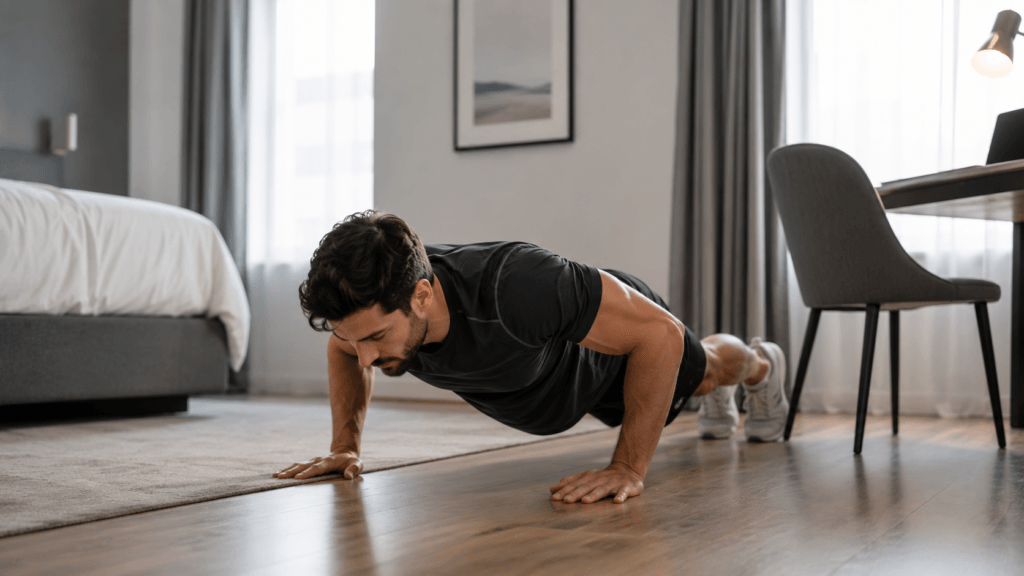
The program requires nothing you need to purchase. It can be performed with floor space and simple surfaces such as a sturdy table or desk, chair, and wall. It is designed to work in places such as a bedroom, hotel room, or park.
Who Should Choose the Bodyweight Edition?
It’s particularly useful if you:
Have no gym equipment
Travel frequently
Live in a small apartment
Don’t want a gym membership
Want to train anywhere
Are getting started with strength training
Need a program that doesn’t depend on equipment
The Bodyweight Edition isn’t simply a collection of random push-ups and squats.
It follows the same structured 30-day framework, including four training days per week, progressive phases, recovery days, a test day, and a final review.
The exercise library also uses progressions and easier variations. For example, push-up variations can progress from easier versions toward more demanding movements, allowing the difficulty to be adjusted to the individual.
The Trade-Off
The main limitation is external loading.
You can’t simply put another plate on a barbell when a movement becomes easy. Instead, progression can come from harder variations, slower tempo, increased repetitions, or other changes to the movement.
That’s why bodyweight training requires a little more creativity when progressing.
But its biggest advantage is difficult to beat:
You can take the workout almost anywhere.
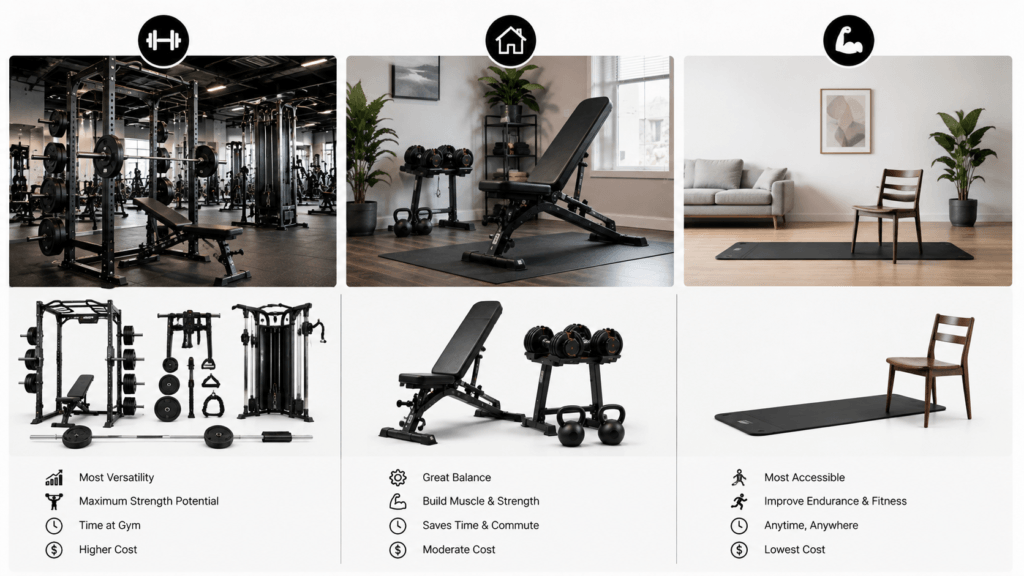
Full Gym vs Home Gym vs Bodyweight
So which one is actually best?
There isn’t one universal winner.
The better question is:
Which environment gives you the highest chance of completing the entire 30 days?
Here’s a practical comparison.
| Feature | Full Gym | Home Gym | Bodyweight |
|---|---|---|---|
| Gym membership | Usually required | No | No |
| Barbell | Yes | No | No |
| Squat rack | Yes | No | No |
| Cable machine | Yes | No | No |
| Dumbbells | Yes | Adjustable dumbbells | No |
| Bench | Yes | Adjustable bench | No |
| Equipment required | High | Low | Minimal |
| Train while traveling | Difficult | Possible | Excellent |
| Exercise variety | Highest | High | Moderate |
| Convenience | Moderate | High | Very high |
| External loading | Excellent | Excellent | None |
| Space required | Gym space | Small space | Very little |
| Best for | Full equipment access | Home lifters | Equipment-free training |
Which Program Is Best for Beginners?
If you’re a beginner, don’t automatically assume you need the Full Gym Edition.
The best program is usually the one that matches your current environment and allows you to learn the movements consistently.
Beginner with no equipment?
Start with Bodyweight.
The program includes easier exercise variations, so you can work from an appropriate starting point rather than trying to perform advanced movements immediately.
Beginner with adjustable dumbbells?
Choose Home Gym.
You get external resistance while keeping the equipment requirements relatively simple.
Beginner with a gym membership?
Choose Full Gym if you are comfortable using the available equipment.
The important thing isn’t choosing the most complicated program.
It’s learning the movements, following the schedule, recording your work, and progressing gradually.
What If I Travel Frequently?
This is where the Bodyweight Edition has a major advantage.
The program is designed to work without gym equipment and can be performed in locations such as bedrooms, hotel rooms, or parks.
If you travel for work, attend school away from home, or simply move between locations frequently, a program that depends on a particular gym setup can become difficult to maintain.
Bodyweight training removes that dependency.
You don’t have to find the perfect gym.
You just need enough space to train safely.
What If I Already Own a Home Gym?
If your setup consists mainly of adjustable dumbbells and an adjustable bench, the Home Gym Edition is the natural fit.
You don’t need to buy a barbell, rack, or cable machine simply to follow the program. The Home Gym Edition was specifically built around the smaller equipment setup.
If you later upgrade to a full setup, you can move to the Full Gym Edition. In fact, the Home Gym program itself points toward the Full Gym Edition as the next option when you have access to a barbell, rack, and cables.
What Happens After the 30 Days?
A 30-day program shouldn’t be treated as something that ends permanently on Day 30.
The final day is designed as a Review & Reset.
You look back at your starting point, compare your results, consider which sessions were hardest, and identify habits worth keeping.
And you can continue progressing after the challenge.
For bodyweight training, for example, you can move toward harder exercise variations or slower tempos. If you acquire dumbbells, you can move into the Home Gym Edition.
For Home Gym training, you can repeat the program with heavier dumbbell settings, use slower tempos, or eventually move into the Full Gym Edition if your equipment changes.
The idea is simple:
The 30 days are a starting block, not the finish line.
Don’t Forget to Track Your Workouts
Following a program tells you what to do.
Tracking tells you what actually happened.
That’s why the programs are designed to work alongside the companion workout tracker.
The training pages provide the session structure, including movements, sets, reps, targets, coach notes, and muscle information. The tracker gives you a place to record the work you actually completed.
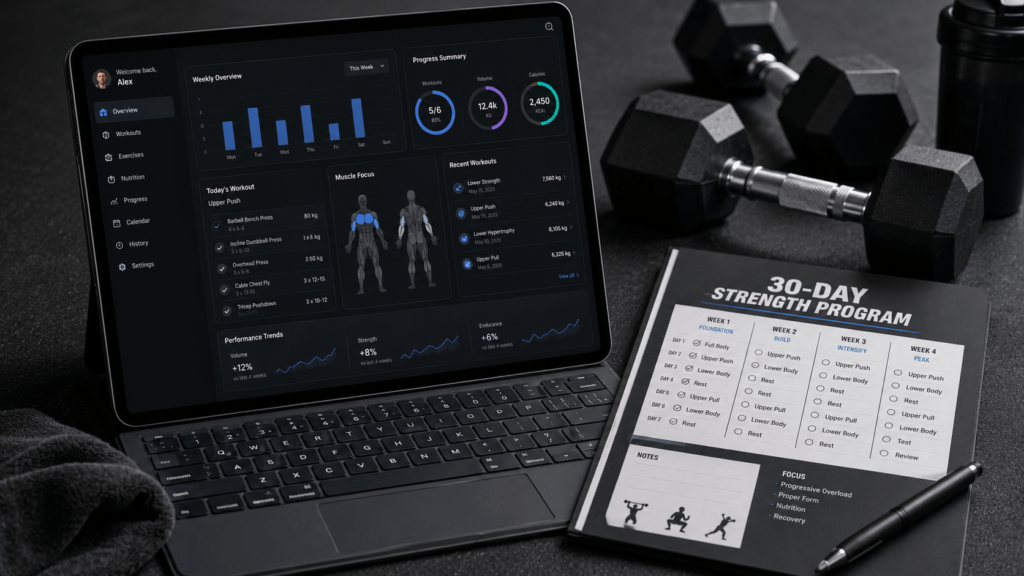
This becomes especially useful when you’re trying to identify whether you’re actually progressing.
Instead of thinking:
“I think I’m getting stronger.”
You can look back at your previous sessions and compare your numbers.
So, Which 30-Day Program Should You Choose?
Use this simple decision guide:
Choose Full Gym if:
You have regular access to a fully equipped gym and want the widest range of exercises and loading options.
Choose Home Gym if:
You train at home and have adjustable dumbbells plus a bench—or want a relatively compact equipment setup.
Choose Bodyweight if:
You have little or no equipment, travel frequently, have limited space, or simply want a program you can perform almost anywhere.
And if you’re still unsure, choose based on where you will actually train most consistently.
The perfect program on paper is useless if you don’t follow it.
The best program is the one that fits your environment well enough that you can show up, complete the sessions, recover, and keep progressing.
Want All Three Options?
If your training environment changes—or you simply don’t want to choose only one—the complete bundle includes all three 30-Day Strength Challenge editions:
Full Gym Edition
Home Gym Edition
Bodyweight Edition
Each edition contains a structured 30-day program with four training days per week, progression phases, recovery days, a Day 29 test, and Day 30 review.
The bundle also includes the Workout Tracker App, giving you a way to continue recording workouts and progress beyond the initial 30-day challenge.
Get the Complete 30-Day Strength System
If you want all three training environments covered instead of committing to just one, you can view the complete 30-Day Strength Challenge + Workout App Bundle here:
View the 30-Day Strength Challenge + Workout App Bundle →
Whether you train in a commercial gym, a small home gym, or with nothing more than your own bodyweight, the goal remains the same:
Choose your environment. Follow the plan. Track the work. Build from there.
Important Note
These programs provide general fitness information and are not a substitute for medical advice, professional coaching, or physical therapy. The program materials recommend warming up properly, training within your ability, and seeking appropriate professional advice if you have an injury, health condition, are pregnant, or have been inactive. Stop exercising and seek advice if you experience sharp pain, dizziness, chest discomfort, or shortness of breath.